Chapter I: Two Months in Tucson
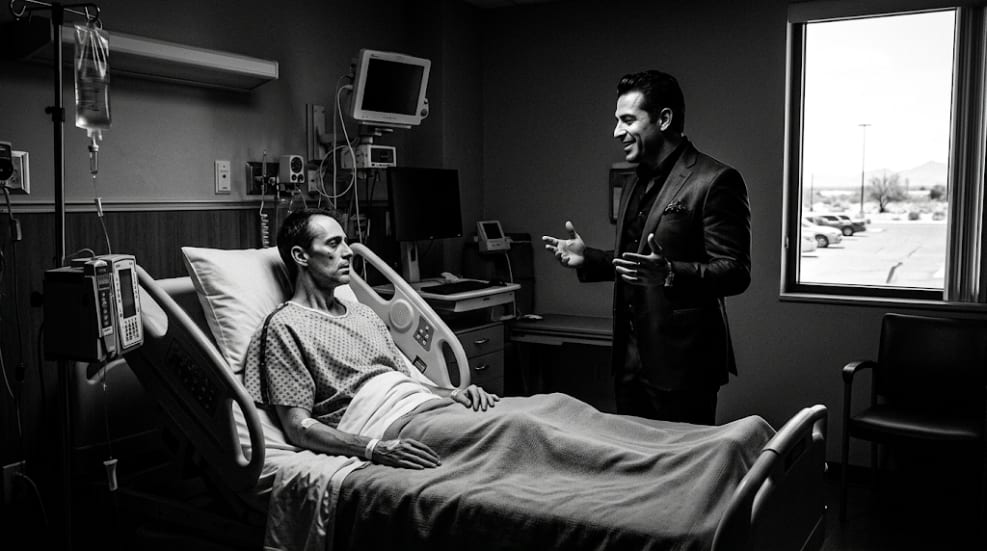
The hospital room was a blinding, clinical void that promised a cure it couldn’t actually deliver. Adam Gutierrez lay pinned to a thin mattress. The starch-stiffened sheets felt like a shroud he wasn’t quite ready to wear yet. He kept replaying the doctors’ voices in his head. He hated the detached way they’d delivered the news of his impending death just moments before slipping out of the room.
Liver Cancer.
The words sat like lead in his stomach, far heavier than the simple ache that had brought him to this ward in the middle of a blistering Tucson July.
It was the finality of it that didn’t make sense. The doctors had tossed out a timeline of two months, but even that felt like a polite lie, a courtesy to a man who was already effectively a ghost. He stared at the window where the desert sun beat down mercilessly on the asphalt of the parking lot below. It was a vibrant, scorching contrast to the cold, terminal reality of the ward.
He felt like a loser. A nobody.
Just another guy who had spent his life trying to keep his head above water in the Old Pueblo, only to be pulled under by a tide he never saw coming.
The door swung open with a flourish that was deeply out of place for a hospital. Damian Diaz barged in, trailing the scent of expensive cologne and the manic energy of a man who owned the world. He didn’t see the IV drips or the gray pallor of Adam’s skin. He only saw his own reflection in the triumph of the day.
“I told you I’d make it happen!” Damian’s voice boomed, echoing off the narrow walls. He began pacing the small room like a caged tiger. He replayed his latest meeting with the dramatic flair of a lead actor, describing how he’d thrown the signed contract onto the table just to watch his rivals choke.
Adam didn’t reply. His mind was trapped in the loop of two months while Damian basked in the glory of some mid-level corporate takeover. Disbelief and hollow hopelessness began to morph into a sharp, lethal rage at the grin his friend carried. Yet, even as the anger burned, Adam felt the familiar, pathetic pull of his own inadequacy.
He didn’t blame Damian for being successful. He blamed himself for being the kind of man who had nothing to show for his forty-five years but a failing liver and a mountain of regret.
The door swung open again, and the silence was shattered by the sharp clack-clack of Fernanda’s old heels against the linoleum. It was a sound that usually signaled an argument in their cramped, uncooled apartment off South 12th. Adam’s expression shifted instantly, his lips flattening into a hard line as he turned his head toward the wall, wishing he could dissolve into the light.
“Damian!”
Fernanda’s voice rang out, charged with an excitement she hadn’t directed at Adam in years. She looked like she’d just walked off her shift at the Dillard’s makeup counter, her face perfectly painted but her energy frazzled.
Damian’s tone dropped into a honeyed sweetness that felt like sandpaper on Adam’s nerves as he started bragging to her about the new deal. Fernanda stopped, smoothing her skirt and clearing her throat as if to compose herself in the presence of greatness. She called him a perfect example of a self-made man, her eyes shining with a hunger that Adam hadn’t seen in a decade.
Damian played modest, but he didn’t lean away from her gaze. The air in the room felt thick with it. It was the private look shared between people who spent their weekends drinking overpriced cocktails downtown rather than sweating it out at the neighborhood dive bars. It was a private bubble Adam wasn’t invited to join, even as he lay dying three feet away.
The sheer injustice of it finally snapped the last thread of his patience.
“You’ve got to be kidding me!” Adam shouted, his voice cracking with physical pain and raw fury. He reached for his pillow, the effort sending a white-hot jolt of agony through his midsection, and hurled it against the wall. “If you want to flirt, do it out in the hall!”
Fernanda didn’t offer comfort. She threw up her hands, her face contorting. “There you go, suspecting me again! I can’t even have a normal conversation without you making it something ugly!”
Damian gave a strained, pitying smile, backing toward the exit to escape before the scene got any messier. The door hadn’t even fully closed before Fernanda turned her venom back on her husband. She snapped that he was just jealous of his friend’s hustle, always blaming everyone else instead of working hard enough to give them a real life.
Adam snapped back, asking why she had even bothered staying with him if all she wanted to do was throw herself at Damian’s feet.
Fernanda didn’t answer. She simply swept out of the room, leaving Adam alone with his curses and his cancer.
Chapter II: The Roots of the Desert
Their friendship was buried in the worn, low-pile carpets of the University of Arizona Main Library, somewhere between the stacks of macroeconomics and corporate law.
Back in the early 2000s, Damian was the student who smelled of effortless confidence and high-end laundry detergent. Adam was the ghost in the front row, fingers perpetually stained with cheap printer ink, chasing the high of a perfect GPA he thought would be his ticket out of south-side poverty. Damian had a way of collecting people. Adam, desperate for a sliver of that reflected light, had let himself be gathered.
They used to spend Friday nights at a dive bar off 4th Avenue, huddled in a dark booth where the smell of stale beer and the heavy, mid-summer Tucson air drifted through the open door. Over cheap pitchers, Damian would spin elaborate yarns about the empires they were going to build.
“The world doesn’t belong to the smartest guys, Adam,” Damian told him once as they walked back toward campus under a thick blanket of desert stars. “It belongs to the ones who can tell the best story. People don’t want the truth. They want to believe in a guy who looks like he already won.”
At forty-five, lying in a hospital bed with a right side that felt like it was packed with hot coals, Adam finally understood.
The split had begun the moment they tossed their caps into the air at Arizona Stadium. Damian stepped straight into a sleek corporate office downtown, while Adam spent his post-grad years walking the cracked, shimmering sidewalks of the city in a thrift-store suit that hung too loose, collecting rejection letters and settling for entry-level data entry.
Then came Fernanda.
Sharp-featured, with eyes that constantly calculated the cost of the air she breathed, she had been Damian’s first real girlfriend. When Damian cut her loose because a real relationship got in the way of his hustle, Adam had stepped right in to catch her. He actually thought he’d won something Damian couldn’t keep.
It took years of marriage for the truth to seep through the drywall. Fernanda didn’t want a partner; she wanted security, and she hoarded money with a frantic, obsessive energy. She secretly tucked away the lion’s share of Adam’s modest paycheck into accounts he wasn’t supposed to know about, all while clipping coupons, policing the thermostat, and making him feel like a parasite in his own home.
Every time they met Damian for drinks at some trendy, overpriced cocktail lounge downtown, he arrived in a new European sedan that looked ridiculous parked against the dusty Tucson curb. He wore watches that cost more than Adam’s annual salary. He played the benevolent king, throwing down his black card and taking them on weekend trips to San Diego. For Adam, every single favor tasted like ash.
After every dinner, Fernanda would return to their apartment, drop her purse, and spend hours tearing Adam down. She called him a dead-end office drone, a man with no drive. Adam never threw the truth back in her face, even after the day he found her hidden stashes of cash tucked behind the water heater. He just handed over his life to her, hoping that if he took enough punishment, she would finally look at him the way she looked at Damian.
It never happened.
The stress turned inward, a quiet poison. Then came the pain in his side, a dull, thumping ache that Adam ignored for six straight months because he didn’t want to hear Fernanda scream about the insurance copay or the cost of a clinic visit. By the time he collapsed on the linoleum at work, the damage was already done.
Liver Cancer.
He sat in the ward, listening to the rhythmic, synthetic hum of the machines, and realized his entire life had been nothing but a footnote to Damian’s grand, fictional narrative. He was going to die in the exact same valley where he was born, having traveled no further than the lies his friend had told him.
Chapter III: The Obsidian Mirage
The door groaned open again on the fourth day, and Fernanda stood there in a charcoal-grey tank top pilling at the seams. It was a costume of poverty that felt like an insult to Adam. He knew she had enough tucked away behind the water heater to cover this entire hospital stay, yet she dressed like a beggar at a funeral. She flicked a termination letter from his employer onto the mattress, her voice a low hiss, telling him he was slipping out the back door without leaving her a single thing to live on.
Adam wheezed, muttering that he didn’t ask for the diagnosis. When he reached for the letter, a white-hot spike of agony shot straight through his ribs. Fernanda didn’t flinch. She just stepped closer, her face tight and cruel.
“I regret the day I married you,” she spat. “I should have stayed with Damian. At least he’s a man who knows how to provide. Why couldn’t you have just died sooner and saved us both the trouble?”
Adam didn’t think. He just swung.
The smack of his palm against her cheek was loud and wet, cutting the air right out of the room.
He stood shaking by the bed, his chest heaving, his hand burning with a strange, electric sting. Fernanda froze, her head jerked sideways, her fingers instantly flying to her face. For the first time in twenty years, the anger in her eyes was replaced by genuine, stunned shock. Without a word, she snatched her purse off the chair and hurried out, the frantic clack-clack of her heels fading down the linoleum corridor.
The adrenaline evaporated instantly, leaving Adam hollow.
In the quiet, feverish nights that followed, his mind began to warp. The cancer and the hospital morphine blurred together, and he convinced himself that Damian was the only anchor he had left. He needed to beg for Damian’s forgiveness for the scene he’d caused, to make sure someone would look after things when he was gone.
By the fifth night, the desperation turned into a manic, chemical strength. Ignoring the buzz of the monitors, he waited until the evening shift change, pulled the IV from his arm, and dragged his clothes on over his gown. He slipped past the distracted nurse’s station and out into the suffocating evening heat, hailing the first yellow cab that rolled past the emergency room bay.
“The foothills,” he told the driver, his voice a raspy whisper. “Campbell and River. The Alta Vista building.”
In all their years of friendship, Adam had never actually set foot in Damian’s office, always respecting the vague security protocols Damian claimed were mandatory for high-level acquisitions. When the cab pulled up, the building looked exactly like the dream Damian had sold. It was a massive structure of mirrored glass and white stone, reflecting the burning orange of the desert sunset.
Adam pushed through the heavy glass doors into a vaulted lobby of cold marble, quiet as the daytime office workers had already headed home. He looked like a corpse already, his skin sallow and his eyes sunken into dark pits. Clutching his side, he stumbled toward the illuminated security desk where an evening guard sat watching the monitors. With a trembling hand, he slid Damian’s gold-embossed business card across the desk.
The guard looked at the heavy card, frowned, and typed a few strokes into the building’s directory computer. After a moment, he looked back up at Adam with a slow, heavy pity.
“Sir,” he said softly. “We don’t have a Damian Diaz in this building. I’ve been the night security manager here for ten years. There’s never been a tenant by that name.”
The air left Adam’s lungs.
He stammered, insisting there was a mistake, mentioning the big entertainment takeovers and the multi-million dollar board meetings. The guard’s expression only softened further. He told him there weren’t any corporate firms like that in the building, and pointed out that the gold leaf on the card was just cheap foil flaking off heavy cardstock.
The marble beneath Adam’s feet felt like it was tilting.
The takeovers, the European cars, the champagne. Every single brick of the life he had envied, the life that had made him feel like a ghost in his own marriage, was made of smoke. Damian wasn’t a corporate king. He was a con man living in the empty spaces between the truth. And Adam wasn’t just a failure. He was the fool who had worshipped the phantom.
His hands were shaking as he pulled out his phone and dialed Damian’s number.
“Hey, Damian,” Adam whispered, staring at his own gaunt reflection in the polished lobby floor. “Where are you?”
“Just wrapped up at the glass palace, my friend!” Damian’s voice chirped through the speaker, buoyant, loud, and entirely bulletproof. “Dinner with the board at Campbell and River. You know how it is.”
Liar.
The word cut deeper than the tumor in his side. Adam’s knees hit the cold marble with a dull thud. A violent, white-hot tear ripped through his stomach, as if his body were finally letting go of the lie it had been keeping alive. As the guard scrambled to dial 911, the shadows surged in from the edges of the room.
In that final, fading pocket of consciousness, Adam felt a bitter, hollow urge to laugh. He had spent his whole life breaking his back against reality, only to be destroyed by a man who didn’t even exist.
The light took him.
Chapter IV: The Ghost of 7:13
Damian Diaz was pacing the worn linoleum of his six-hundred-square-foot studio apartment on the rougher edge of town, riding the high of the lie he’d just fed Adam, when his phone rang.
The air in the room was thick, smelling faintly of old takeout and the sour stink of a neglected litter box tucked in the corner by the bathroom door. The voice on the line belonged to an administrator at the county hospital, flat, professional, and entirely unbothered by the weight of what it was delivering. They had found Damian’s number at the absolute top of the call log on a dead man’s phone.
“Mr. Gutierrez passed away this evening,” the voice said. “Found him in the lobby of a building up on Campbell. He had an outgoing call to this number logged at exactly 7:13, right before he collapsed.”
Damian’s hand froze against the plastic casing of the buzzing window A/C unit.
7:13.
He looked down at the screen. That was the exact minute his phone had lit up with Adam’s name. The very second he had been bragging about a nonexistent boardroom, Adam had been taking his last breath on the cold marble floor across town.
At the funeral, held under a heavy, overcast Tucson sky that threatened a monsoon rain it couldn’t quite deliver, that number echoed in Damian’s chest like a heartbeat. Looking at Fernanda, red-eyed and frantic in her cheap black dress, a cold dread began to crawl up his spine. Had Adam left a paper trail? A confession to a nurse? A letter hidden away that would peel off Damian’s expensive, borrowed skin and show the city exactly what he was?
Desperate to outrun the quiet, Damian threw himself deeper into his current grift. He was working a wealthy local family named the Thompsons, trying to bleed them dry with a fake foothills real estate development. But by the time they sat down for dinner at a high-end steakhouse near the resort, the mask was slipping.
He started seeing Adam.
It wasn’t a spectral figure in white. It was just Adam, looking exactly like he did in the hospital ward. He was there in the dark reflection of the red wine glasses. He was sitting silently in the backseat of the sedan when Damian adjusted his rearview mirror, sallow-skinned and staring with heavy, sunken eyes that knew every single secret.
“I know what you’re doing! You’re not dead!” Damian snapped suddenly, his voice cracking across the white tablecloth during a lull in the conversation. The Thompsons froze, forks suspended halfway to their mouths.
Damian bolted to the restroom, splashing cold water onto his face, but when he looked into the mirror, the glass felt wrong. He stumbled out into the blistering asphalt parking lot, the heat rising from the ground like a furnace, gasping for air that felt like pure fire in his lungs.
When the Thompsons followed him out to check on their investment, Damian saw him again. Adam was standing right behind Mr. Thompson’s shoulder, completely still in the shimmering heat haze, watching him with an awful, unblinking clarity.
“What are you doing here? Tell them!” Damian yelled, pointing a trembling finger at the empty desert air. “Tell them what you know!”
The Thompsons didn’t wait to hear the rest. Terrified by the sudden, ugly crack in his polished surface, they backed away into their car and tore out of the parking lot, taking their millions with them.
The end didn’t come with a dramatic arrest or a courtroom exposure. It came with the quiet, crushing weight of the city.
A month later, Damian sat near the back of a Sun Tran bus, the air conditioning doing nothing but moving the hot, stale air around. His expensive Italian suit was rumpled and stained with sweat. It smelled faintly of the cheap dive bars where he’d spent his remaining cash. His eyes were bloodshot from weeks of looking over his shoulder at a ghost that never stopped following.
He looked at the torn vinyl seat beside him and whispered into the dark, “Are you happy now? Look at me. I’m done. No more stories.”
A teenager a few rows up pulled off his headphones, gave Damian a long, uneasy look, and moved toward the front of the bus. Damian didn’t even notice. The lie was entirely over. There were no fake corporate takeovers left to pitch, no borrowed lifestyle to flash in front of a woman who never really loved the real him anyway.
He was just another broken soul on a bus cutting through the Tucson dust. He had nothing left to his name but the ghost of 7:13 riding shotgun, finally forcing him to live in the truth.